
Table of Contents
Shopify Plus simplifies B2B operations for Australian businesses by offering tools to manage wholesale and retail from one platform. It supports customer-specific pricing, flexible payment terms, and tailored catalogues, all while ensuring compliance with GST and local tax regulations. Key Shopify Plus B2B features include:
- Company Profiles: Manage multiple buyers and locations with unique pricing, tax IDs, and payment terms.
- Blended Stores: Serve both B2B and DTC customers using one inventory and checkout system.
- Custom Pricing & Catalogues: Create price lists and catalogues tailored to individual buyers or groups.
- Flexible Payment Options: Offer terms like Net 30, invoicing, and vaulted credit cards for smoother transactions.
- Automation & Integrations: Use Shopify Flow for tasks like tagging VIP customers and integrating with ERP or CRM systems.
Shopify Plus helps Australian businesses streamline wholesale transactions while scaling efficiently in the growing digital B2B market.
Shopify B2B Tutorial - Using the Shopify Plus B2B features with your Shopify Plus store
Core Shopify Plus B2B Features
 Shopify Plus vs Standard Shopify B2B Features Comparison
Shopify Plus offers a robust set of native tools tailored for B2B operations, all seamlessly integrated into the Shopify admin. These features allow Australian businesses to manage wholesale and retail channels from a single platform, reducing reliance on third-party apps. By streamlining B2B sales processes and cutting down on manual tasks, Shopify Plus creates a smooth, consumer-like experience for wholesale buyers. Here’s a closer look at the standout features that support B2B operations in Australia.
Company Profiles and Buyer Accounts
Shopify Plus simplifies managing B2B customers by treating them as "companies" within the admin. These act as parent accounts, accommodating one or more locations. Each location can have its own tax ID, tax exemptions, shipping and billing details, pricing, and payment terms. When dealing with multi-location companies, buyers can select the relevant location to ensure accurate settings and pricing.
The platform also offers two levels of buyer permissions. The "Ordering only" role allows users to place orders for their assigned location and view their own purchase history. Meanwhile, the "Location admin" role provides additional access to review all orders for that location and update shipping or billing information. These self-service tools empower buyers to manage their accounts, track orders, and make bulk purchases without needing constant support, easing the workload for sales and customer service teams.
For Australian businesses working with resellers, Shopify Plus includes built-in tax exemption management. This feature allows exemptions to be applied at the company or location level, simplifying GST compliance for wholesale transactions. Additionally, company profiles store key details like multiple contacts, pricing tiers, payment terms, and order limits, making order processing and customer management more efficient.
Blended B2B and DTC Stores
One of Shopify Plus’s standout features is its ability to handle both B2B and direct-to-consumer (DTC) operations from a single platform. This unified system eliminates the need for separate setups. Australian businesses can manage one inventory, one admin dashboard, and one checkout system while catering to both wholesale and retail customers.
The platform customises the shopping experience based on the customer’s account type. Wholesale buyers see custom catalogues, negotiated pricing, and B2B-specific payment options, while retail customers access standard product listings and consumer-focused checkout flows. This setup is particularly useful for Australian brands expanding from DTC into wholesale or for wholesalers venturing into retail.
B2B vs Standard Shopify Features
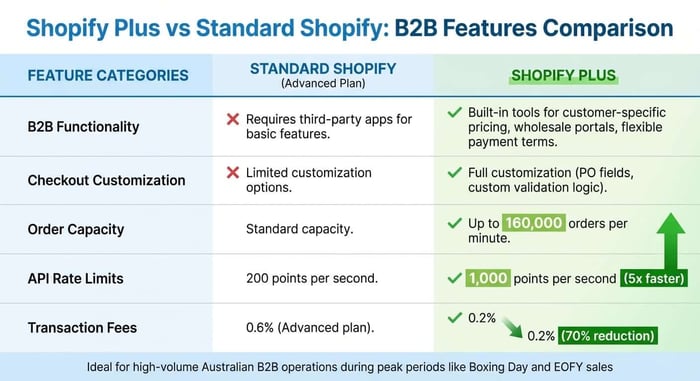
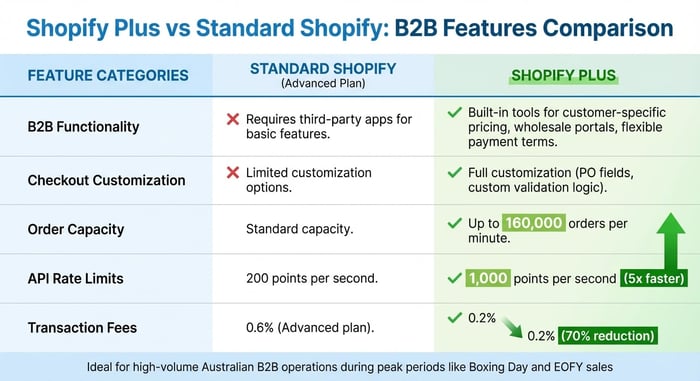
Shopify Plus significantly enhances wholesale functionality compared to standard Shopify plans. While standard plans often rely on third-party apps for basic B2B features, Shopify Plus provides built-in tools for customer-specific pricing, wholesale portals, and flexible payment terms. Additionally, the platform enables full checkout customisation, allowing businesses to add features like purchase order fields or custom validation logic.
Scalability is another key advantage. Shopify Plus can handle up to 160,000 orders per minute, ensuring stability during high-demand periods like Boxing Day or end-of-financial-year sales in Australia. It also supports API calls at five times the rate of standard plans (1,000 vs 200 points per second), enabling smoother integrations with ERP and CRM systems. For high-volume wholesale operations, the transaction fee reduction - from 0.6% on the Advanced plan to 0.2% on Shopify Plus - translates into substantial savings.
Pricing and Catalogue Management
Shopify Plus uses catalogues as a central tool for managing what B2B customers see and pay. These catalogues let Australian businesses customise their wholesale offerings, defining product availability and pricing for specific buyers without disrupting their retail storefronts. This setup ensures a smooth B2B experience, tying back to the platform's overall functionality. Following this, we’ll explore how tailored price lists and volume discounts encourage larger orders.
Price Lists and Volume Discounts
With Shopify Plus, businesses can create customer-specific price lists. These can be set as percentage-based adjustments across entire catalogues or as fixed prices for individual items, with fixed prices taking priority. This flexibility is particularly relevant in Australian wholesale, where pricing often varies between independent retailers and large distributors due to negotiated agreements.
Volume pricing, on the other hand, encourages bigger orders by establishing quantity thresholds, minimum and maximum order rules, and specific increments. For example, a supplier might require orders in multiples of 12 or set a minimum order value to offset shipping costs.
Take WHO IS ELIJAH, for instance. This fragrance brand achieved a 50% year-over-year growth in international wholesale revenue by using customised pricing matrices tailored to different B2B categories. These strategies highlight how personalised pricing can significantly impact wholesale success.
Customer-Specific Catalogues
Shopify Plus also allows businesses to manage product visibility through tailored catalogues. These catalogues can include all products or specific selections, supporting exclusive distribution or regional variations. For example, products can remain hidden from retail customers but visible to wholesale buyers, ensuring exclusivity.
When multiple catalogues are assigned to a single company location, all products are displayed. If duplicate products exist with different prices, the lowest price (excluding volume discounts) is shown. Catalogues can be managed directly in the Shopify admin under Markets > Catalogues or updated in bulk using CSV files. This level of control ensures businesses can adapt their offerings to meet specific customer needs.
Global vs Customer-Specific Catalogues
Choosing between global and customer-specific catalogues depends on operational needs and customer segmentation. Here's how they differ:
| Aspect | Global Catalogues | Customer-Specific Catalogues |
|---|---|---|
| Product Visibility | All buyers see the same product range | Tailored product selection for specific buyers or groups |
| Pricing Control | Standard wholesale pricing applies universally | Custom pricing for individual customers or segments |
| Management Complexity | Easier to maintain with fewer catalogues | Requires ongoing management of multiple catalogues |
| Best For | Businesses with consistent wholesale pricing and offerings | Brands with diverse buyer tiers or exclusive agreements |
| Flexibility | Limited customisation for buyers | Highly flexible for personalised strategies |
For Australian businesses, the decision often boils down to complexity. Brands with straightforward wholesale needs might opt for a single global catalogue, while those catering to varied customer relationships - whether across states or export markets - can benefit from the detailed control offered by customer-specific catalogues.
Checkout and Payment Workflows
After implementing tailored catalogues and pricing strategies, the next step in enhancing the B2B experience lies in refining the checkout and payment workflows. Shopify Plus takes the unique needs of Australian B2B buyers into account by offering features like wholesale pricing, assigned payment terms, and preferred payment methods - all displayed as soon as approved buyers log in. Let’s dive into how customisation, payment flexibility, and streamlined ordering improve the B2B checkout process.
Merchants can gather essential checkout data, such as PO numbers and ABNs, using Checkout UI extensions and Shopify Functions. These tools also enable custom delivery options and payment logic tailored to specific business needs.
Checkout Customisation
Shopify Plus provides a flexible extension framework that allows businesses to implement custom validation rules and conditional fields, tailored to buyer types and Australian tax requirements. For instance, the "Checkout to draft" feature simplifies order approval processes. It lets merchants hold orders for review in the admin before fulfilment - a particularly practical solution for high-value purchases or first-time customers.
Flexible Payment Options for B2B
Payment flexibility is a cornerstone of wholesale transactions, and Shopify Plus delivers with a variety of automated payment terms. Options include Net 7, Net 15, Net 30, Net 45, Net 60, Net 90, and even "due on fulfilment" arrangements. These terms are tied to individual company profiles, ensuring buyers see their negotiated conditions at checkout.
Merchants can also create draft orders for buyers to review and convert into invoices, offering an added layer of transparency. For faster transactions, securely stored (vaulted) credit cards are supported, and PayPal is available as a payment option. Payments made through these methods are automatically reconciled in the Shopify admin, making bookkeeping more efficient.
Quick Ordering and Reordering
For high-frequency buyers, speed is everything. Shopify Plus addresses this need with bulk ordering grids, enabling buyers to quickly select multiple product variants either from product pages or dedicated order forms. The platform also includes a convenient reordering feature within customer accounts, making repeat purchases seamless. While advanced options like bulk adding to cart via CSV import or SKU copy-pasting require custom development, the built-in tools effectively handle most wholesale ordering scenarios.
sbb-itb-a0ae8a5
Operations and Integrations
Once you've streamlined checkout and payment processes, the next step is to focus on backend operations. By integrating frontend efficiencies with backend automation, businesses can create a smooth and connected order lifecycle. Shopify Plus simplifies this process by merging B2B and DTC operations into a single platform, reducing development challenges.
Workflow Automation with Shopify Flow
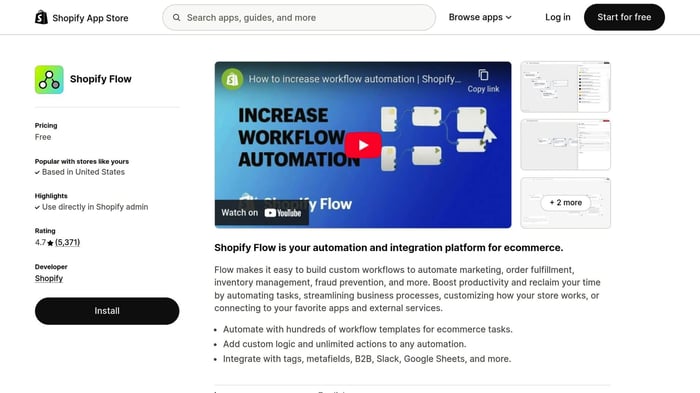
Shopify Flow is a no-code automation tool designed around a straightforward "trigger, condition, action" framework. For B2B businesses, this tool eliminates the need for developers to handle repetitive tasks. For example, when an order exceeds A$1,000, Flow can automatically tag the customer as "High-Value B2B", notify the account manager via Slack, and flag the order for express fulfilment. Other workflows include tasks like auto-approving eligible accounts, assigning price lists, or alerting account executives when VIP customers haven't made a purchase in 90 days.
"The result? Lower costs, fewer errors, and more time for higher-value activities, such as nurturing client relationships or tackling strategic projects - activities especially critical in B2B." - Nick Moore, Shopify
Inventory and Fulfilment Integration
Shopify Plus supports multi-location inventory management, letting businesses monitor stock across warehouses, stores, and fulfilment centres. Its APIs make it easy to integrate with external systems like ERP, CRM, and accounting software (including popular Australian options like Xero and MYOB), as well as fulfilment platforms. The Fulfilment Orders API further simplifies 3PL integration by automating order routing, syncing inventory in real time, and sending customer notifications. For businesses with complex inventory needs, tools like Prediko can complement Shopify Plus by offering AI-powered forecasting, automated purchase orders, and detailed reporting. These integrations strengthen the operational framework needed for scaling B2B operations.
Shopify Plus B2B Features vs External Systems
| Capability | Shopify Plus Native | External Systems (ERP/Inventory Apps) |
|---|---|---|
| Multi-location inventory | Unlimited locations, smart allocation, transfer orders | Advanced forecasting, reorder point automation |
| Workflow automation | Shopify Flow for order routing, customer tagging, notifications | Complex approval chains, vendor communication |
| Financial management | Basic cost tracking, payment reconciliation | Full accounting integration (Xero, MYOB), purchase orders |
| Reporting | Standard inventory and sales reports | AI-driven analytics, daily email notifications, custom dashboards |
| Fulfilment | Basic order management, API for 3PL connections | Automated warehouse allocation, multi-channel order management |
Deciding what to handle natively within Shopify Plus versus through external systems depends on your business's specific needs. For most Australian B2B companies, Shopify Plus's built-in features cover essential requirements. However, integrating with accounting tools and specialised inventory apps can address more complex operational demands. These capabilities allow Australian businesses to scale effectively while maintaining the flexibility required for tailored B2B operations.
Scaling B2B Operations on Shopify Plus
Structuring for Growth
As your wholesale business grows, managing customer tiers, pricing structures, and catalogues becomes increasingly important. Shopify Plus makes it possible to handle both B2B and direct-to-consumer (DTC) operations on a single platform.
At the heart of Shopify Plus's B2B functionality are Company Profiles, which provide a scalable way to manage wholesale operations. These profiles allow you to oversee multiple buyers across various locations, each with tailored permission levels, payment terms, tax exemptions, and payment methods. This centralised system helps streamline operations, even as your network of wholesale clients expands. Whether you’re segmenting customers by industry, region, or purchase volume, you can assign customised price lists and catalogues that reflect the specific terms of each relationship.
When expanding internationally, localisation becomes essential. Adjusting for local currencies, payment methods, tax regulations, and regional preferences ensures smoother operations. Shopify Plus supports these needs with its multi-currency and multi-language features, enabling you to create region-specific catalogues while maintaining efficiency through a single backend. This unified system also facilitates regional customisation, seamlessly integrating with your overall catalogue management strategy. Next, we'll look at how to track and optimise the performance of your B2B operations.
Tracking and Optimising B2B Performance
Shopify Plus offers advanced reporting tools that provide insights across all your stores and sales channels. The platform's B2B analytics dashboards help pinpoint which companies generate the most revenue and which pricing strategies deliver the best profitability. You can also analyse search queries, reorder patterns, and purchasing trends to uncover growth opportunities.
Key metrics worth monitoring include the average order value for each customer segment, the adoption rates of self-service tools like quick reorder options, and the frequency of repeat purchases. ShopifyQL Notebooks allows you to create custom reports tailored to your specific data needs. For Australian businesses, tracking these metrics can highlight high-value accounts that may benefit from dedicated account management, identify customers at risk of churning, and refine pricing strategies based on actual purchasing behaviour rather than assumptions.
Conclusion
Shopify Plus provides Australian businesses with a robust solution to streamline B2B operations. By consolidating processes into a single platform, it helps reduce the reliance on multiple systems and minimises tech debt as wholesale operations grow.
As the Australian B2B ecommerce market evolves - with increasing demands for self-service options, automation, and the ease of B2C-style transactions - Shopify Plus rises to meet these needs. It offers features like customised catalogues, flexible pricing models, tailored payment terms, and self-service portals, all designed to simplify wholesale transactions.
The key to making the most of Shopify Plus B2B features lies in balancing personalisation with efficiency. By delivering a seamless digital experience that aligns with consumer expectations, businesses can successfully manage the complexities of wholesale operations.
To maximise these benefits, treat your B2B digital strategy with the same focus as your direct-to-consumer (DTC) efforts. Use analytics to gain insights into purchasing behaviours, refine pricing strategies, and enhance the buyer experience. As discussed earlier, integrating workflows with data-driven insights ensures your business stays competitive in a rapidly digitising market.
FAQs
How does Shopify Plus help Australian businesses simplify B2B operations?
Shopify Plus makes managing B2B operations easier for Australian businesses by providing features like customised wholesale catalogues, personalised pricing, and flexible checkout options. These tools are designed to accommodate local payment methods and transactions in Australian dollars (AUD), ensuring a smooth experience for both businesses and their customers.
The platform also simplifies day-to-day tasks with automation tools such as Shopify Flow. It allows businesses to efficiently handle multiple buyer profiles using role-based permissions and integrates seamlessly with ERP and CRM systems. This not only reduces manual work but also supports business growth and scalability in Australia’s competitive market.
What are the advantages of combining B2B and direct-to-consumer (DTC) sales on Shopify Plus?
Using a single Shopify Plus store to handle both B2B and DTC sales can streamline your operations by consolidating wholesale and retail channels onto one platform. This approach not only simplifies management but also cuts down on tech-related complexities, making it easier to cater to different customer groups.
Shopify Plus offers features like customised storefronts, flexible pricing options, and automation tools that help you deliver smooth shopping experiences for both businesses and individual buyers. Plus, it supports integrations and workflows tailored to Australian businesses, giving you the tools to operate efficiently and scale as your business expands.
How does Shopify Plus help manage customised pricing and product catalogues for wholesale customers?
Shopify Plus simplifies the process of managing customised pricing and product catalogues for wholesale customers. With features like tailored product listings for specific clients, adjustable pricing tiers, and volume-based discounts, you can create offers that match the unique needs of individual buyers or regions. This approach ensures that each wholesale customer sees the products and prices most relevant to them, making their purchasing journey smoother and more efficient.
On top of that, Shopify Plus supports personalised storefronts and localised content, giving you more control over how you engage with your wholesale clients. These tools not only improve the customer experience but also streamline your operations, helping you grow and scale your B2B business seamlessly within the Australian market.