
Table of Contents
- Setting the Foundation for E-commerce Success in Australia
- Selecting the Right Shopify Plan for Scalability
- Advanced Store Customisation for the Australian Market
- Mastering Payments and Transactions in Australia
- Essential Apps and Integrations for Australian Stores
- Using Financial Data for Strategic Growth
- Building a Resilient E-commerce Operation
- Sources
- FAQs
Since 2020, Australian e-commerce has seen unprecedented growth, shifting the goalposts from simply being online to being strategically optimised. For established businesses, success is no longer about a basic Shopify Australia store setup guide; it's about fine-tuning every aspect of the platform to build a resilient, scalable operation.
Setting the Foundation for E-commerce Success in Australia
If your business is already established on Shopify, you know the platform is more than just a digital shopfront. It’s the engine room of your entire retail operation. The real challenge isn't getting started, but evolving your setup to handle increased volume, meet local customer expectations, and drive profitable growth. At The Hope Factory, we see businesses unlock their next stage of growth when they shift focus from initial setup to strategic fine-tuning. This requires a deliberate approach to every component of your store.
This guide provides actionable advice for refining your Shopify plan, mastering Australian payment systems, and leveraging advanced features for scalability. We will cover the key pillars for optimisation: selecting a plan that grows with you, advanced customisation for the Australian market, navigating the local payment landscape, and using data for operational planning.
Selecting the Right Shopify Plan for Scalability

Choosing a Shopify plan isn't a set-and-forget decision. As your business scales, the plan that served you well initially can become a bottleneck. The conversation often turns to Shopify Plus Australia when certain trigger points are reached. These aren't just about vanity metrics; they are clear indicators that your operational needs have outgrown your current setup. Key triggers include hitting an annual turnover of over $1M AUD, requiring more API calls for custom integrations, or needing a dedicated wholesale channel that doesn't feel like a workaround.
The decision to upgrade is a cost-benefit analysis. While the monthly fee for Shopify Plus is higher, the savings on transaction fees and the efficiency gains from advanced features can deliver a significant return on investment. For high-volume stores, the custom, lower transaction rates alone often justify the cost.
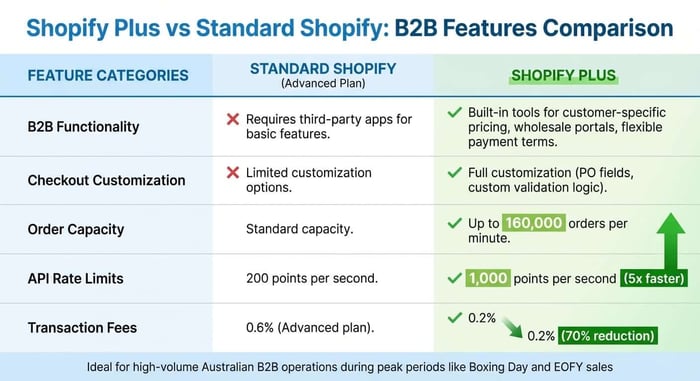
| Factor | Shopify Advanced | Shopify Plus Australia |
|---|---|---|
| Transaction Fees (Shopify Payments) | 2.4% + 30c | Custom rates, typically lower |
| Staff Accounts | 15 | Unlimited |
| Automation | Basic Shopify Flow | Advanced Shopify Flow with more triggers |
| Checkout Customisation | Limited branding options | Full control with checkout.liquid |
| API Call Limits | Standard rate limits | 200% higher API limits |
| Wholesale Channel | Via third-party apps | Dedicated B2B on Shopify channel |
Note: This table compares key scaling features. Custom Shopify Plus pricing is negotiated based on sales volume, making it a cost-effective choice for high-turnover businesses.
Are you ready for an upgrade? Ask yourself these questions:
- Are transaction fees becoming a significant cost centre in your P&L?
- Do you need to automate complex, repetitive workflows with Shopify Flow?
- Is your team constrained by the 15-person limit on staff accounts?
- Do you want to fully customise the checkout experience to match your brand?
Advanced Store Customisation for the Australian Market
Localisation for an Australian audience goes far beyond setting your currency to AUD. It’s about creating an experience that feels intuitive and trustworthy to local shoppers. This requires a thoughtful approach to your store's design and functionality.
Tailoring the User Experience for Aussie Shoppers
To effectively customise your Shopify theme for Australia, you need to think like your customer. This means integrating with Australia Post or Sendle to provide accurate, real-time shipping estimates directly in the cart. It also involves structuring your marketing calendar and site promotions around major local sales events like Boxing Day, not just Black Friday. Using Liquid, Shopify's templating language, you can create unique branding elements that resonate locally. As we demonstrated in our work with Robert Gordon, thoughtful customisation can transform a standard theme into a distinct brand experience that improves site speed and user engagement.
Optimising for Mobile Commerce
Australians are avid mobile shoppers. A recent report from Australia Post highlights that over 80% of households shop online, with mobile devices being a primary channel. Your store must be designed for thumbs, not just mouse clicks. This means testing your mobile checkout process relentlessly to remove friction. Are the form fields easy to fill? Is the layout clean on a smaller screen? Every extra tap is a potential reason for a customer to abandon their cart. Prioritise a mobile-first design that ensures a seamless experience from discovery to purchase.
Building Trust on Product Pages
Trust is the currency of e-commerce. On your product pages, this is earned through transparency. Clearly display that prices are inclusive of GST to avoid checkout surprises. Showcase reviews from verified Australian customers to build social proof. Displaying local business accreditations or certifications also reinforces your credibility. These small details collectively signal to a customer that you are a legitimate, professional Australian business they can rely on.
Mastering Payments and Transactions in Australia

Your payment setup is the final, critical step in the customer journey. A clunky or confusing payment process is one of the fastest ways to lose a sale. For Australian merchants, mastering this means understanding local preferences and compliance requirements.
Shopify Payments vs. Third-Party Gateways
Shopify Payments is the integrated, default option, offering streamlined management directly within your admin. The Shopify Payments Australia fees are competitive and transparent, and you avoid the additional transaction fee that Shopify applies when you use a third-party gateway. However, providers like Stripe or eWay may offer specific features or slightly better rates for certain business models. The key is to analyse your average transaction value and volume to determine which solution is most cost-effective. Also consider settlement times; Shopify Payments typically settles funds in two business days in Australia.
Navigating GST Compliance
Goods and Services Tax (GST) is a non-negotiable part of doing business in Australia. Incorrectly handling it can lead to serious issues with the ATO. Shopify makes this relatively straightforward. In your settings, you can configure your store to automatically apply the 10% GST to all sales within Australia. Ensure your product prices are set to be inclusive of tax, and Shopify will calculate and display the GST component on invoices and at checkout, ensuring full compliance and transparency for your customers.
Embracing Buy Now, Pay Later (BNPL)
Buy Now, Pay Later services like Afterpay and Zip are deeply embedded in Australian shopping culture. Integrating them at checkout can significantly increase conversion rates and average order value (AOV). While these services come with a merchant fee, typically higher than standard card rates, the benefits often outweigh the costs. The decision to offer BNPL should be based on your target demographic and profit margins. For many businesses, it's no longer an optional extra but an essential tool for meeting customer expectations.
Essential Apps and Integrations for Australian Stores
The Shopify App Store is vast, but a scattergun approach can slow down your site and complicate your workflow. The best Shopify apps for Australian stores are those that solve specific local challenges and integrate seamlessly into your operation. Focus on these strategic categories:
- Logistics and Shipping: Apps that integrate directly with Australia Post, Sendle, and other local couriers are essential. They provide real-time shipping rates at checkout, automate label printing, and handle tracking notifications, which saves your team countless hours.
- Marketing and Communication: Look for SMS and email marketing platforms that understand Australian regulations, such as spam laws and time-zone-sensitive sending. Platforms with local support can provide more relevant strategic advice.
- Customer Reviews: Building social proof is critical. Use review platforms that are popular with Australian consumers and allow for photo or video reviews, which add a layer of authenticity.
- Omnichannel Retail: For businesses with a physical presence in cities like Melbourne or Sydney, connecting Shopify POS is a must. It unifies your inventory, sales, and customer data, creating a single source of truth for your entire business.
- Loyalty and Subscriptions: Encourage repeat business with apps that facilitate recurring revenue through subscriptions or reward programs. Tailor your rewards to what Australian shoppers value, such as free shipping or exclusive access to new products.
Choosing and integrating the right apps requires expertise. Working with certified Shopify Experts ensures your tech stack is powerful, efficient, and perfectly aligned with your business goals.
Using Financial Data for Strategic Growth

Your Shopify dashboard is more than a record of sales; it's a tool for strategic planning. Effective use of Shopify financial reporting and analytics turns historical data into a roadmap for future profitability. Instead of just looking at revenue, focus on the metrics that drive decisions. For example, track your customer lifetime value (CLV) against your cost per acquisition (CPA) to measure the true ROI of your marketing campaigns. If your CPA is rising, it's a signal to re-evaluate your ad strategy.
Use sales data to forecast inventory needs, especially for peak Australian shopping seasons like Christmas and End of Financial Year sales. This helps you avoid costly stockouts on your bestsellers or over-investing in slow-moving products. You can also analyse customer behaviour reports to identify which postcodes have the highest conversion rates. This insight allows you to target local ad campaigns with geographic precision, maximising your return on ad spend (ROAS).
Create custom reports within Shopify to monitor the financial health of your business. A simple report tracking cash flow, net profit, and ROAS can provide a clear, at-a-glance view of your performance, empowering you to make proactive, data-driven decisions rather than reactive ones.
Building a Resilient E-commerce Operation
Sustained growth in the competitive Australian market requires moving beyond the basics to strategic optimisation. It’s about creating a resilient, efficient, and intelligent operation that can adapt to whatever comes next. By now, it should be clear that this involves a holistic approach. You need to select the right plan for scale, customise your store for a local audience, master the Australian payment ecosystem, and use your financial data to make informed decisions. Each of these pillars supports the others, creating a powerful foundation for long-term success.
Ready to elevate your Shopify store's performance? Book a chat with our team today.
Sources
- Australia Post. (2023). Inside Australian Online Shopping Report.
- Shopify. (2026). Shopify Pricing Plans.
- Australian Taxation Office. (2026). GST for online sales.
FAQs
Is Shopify Plus worth the cost for an Australian business doing under $2M in revenue?
It can be. The value of Shopify Plus often comes from features beyond lower transaction fees. If you need to automate complex workflows with Shopify Flow, require deep checkout customisation to improve conversion, or need higher API limits for integrations, the ROI can be significant even before you hit higher revenue tiers.
How do I correctly handle GST for both domestic and international sales on Shopify?
Shopify's tax settings allow you to automatically apply 10% GST for all Australian orders while exempting international orders from GST. For selling overseas, Shopify Markets helps manage international tax and duty calculations at checkout, ensuring compliance and a transparent experience for your customers.
What is the single most important optimisation for reducing cart abandonment in Australia?
Providing transparent, fast, and affordable shipping options. Australian shoppers are particularly sensitive to shipping costs and delivery times. Integrating with local carriers like Australia Post to offer accurate, live shipping rates at checkout is one of the most effective ways to build trust and reduce cart abandonment.